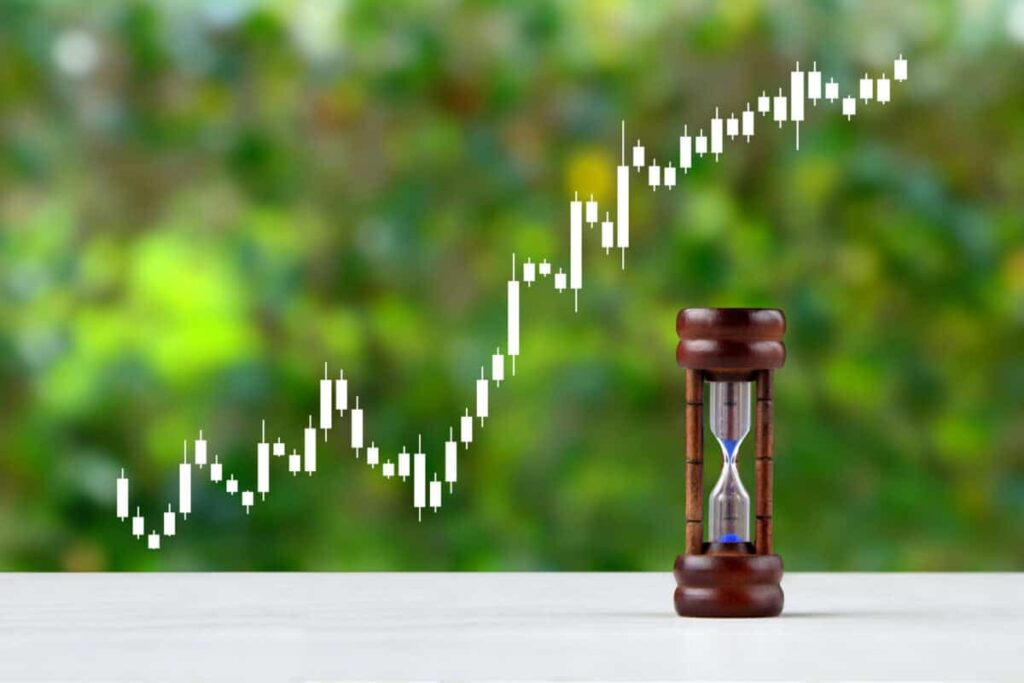
If you’ve ever looked back at a stock chart and thought about how much money you could have made by buying and selling at the right times, you’re certainly not alone.
With hindsight, the opportunities can look obvious. You can see exactly where a stock peaked, when it bottomed, what caused those movements and how much you could have earned between those points.
However, making those decisions while events are unfolding is considerably harder, especially when your own money is involved.
After all, it’s easy to feel confident after stocks have rallied for months. It’s also understandable to want to sell when markets are falling, and every headline gives you another reason to worry.
Plus, unexpected events like the pandemic can change the outlook almost overnight. And this year’s war in Iran shows how even risks investors can see building can still have consequences that last far longer than expected.
So, even when you think you’ve spotted a pattern or figured out what comes next, predicting how stocks will behave in the short term is still incredibly difficult.
The good news is that building wealth doesn’t require you to keep getting those predictions right. In fact, one of the best ways to build wealth is by doing almost the opposite.
Forget market timing: Buy high-quality stocks for the long haul
One of the biggest problems with market timing is that you need to get more than one decision right.
Even if you sell before a decline, you still need to decide when to buy back in. And stocks often start recovering before the news gives you much reason to feel confident, meaning you can miss some of the most attractive buying opportunities.
That’s why investing for the long haul makes so much sense. When you buy a stock, you’re buying part of a business. You can benefit from the profits it pays out to shareholders and the value it creates by reinvesting in growth.
And when you buy high-quality stocks, those benefits can continue to compound as the economy grows, demand for goods and services increases and the best companies find new ways to innovate and create more value.
Of course, the price you pay still matters, so you can’t ignore valuations. However, once you find high-quality businesses that are reasonably priced, the focus becomes giving them as much time as possible to grow and compound your capital.
That way, your returns can be supported by the expansion of their operations and rising earnings over time, rather than depending entirely on someone paying a higher valuation in the future.
And if you still have trouble deciding when to invest, dollar-cost averaging can help reduce the temptation to speculate because investing a set amount each payday or month takes some emotion out of those decisions, which is often one of the hardest parts of investing.
How to make long-term investing easier
Although committing to hold a stock for years might sound stressful, remember that you’re not actually obligated to do so. The goal is to find businesses you understand and could see continuing to lead their industries for years or even decades.
Because once you’re confident in their long-term growth potential, you have a reason to hold them that goes well beyond what the market is doing today.
For example, Dollarama (TSX: DOL) is an incredibly popular discount retailer and one of the best-known brands across Canada.
So, not only do its business model and brand help it consistently attract customers, but it also has significant growth potential as it increases sales at existing locations and opens new stores in Canada and internationally.
That’s why, even after earning investors a total return of more than 500% over the last decade, it continues to be a favourite among long-term Canadian investors.
And with Dollarama just one of many Canadian stocks with the potential to deliver serious gains over the long haul, finding more of those businesses and giving them time to grow is a much simpler strategy than trying to time the market.